
SVSU Winter 2020
About Me
I am a freshman nursing major at Saginaw Valley State University. my hobbies are playing softball, studying and working out. I identify myself as a successful and driven person. I take pride in everything I do.

The Underlying Capacity of Maps
I am currently taking topics in critical writing course through SVSU. I am working on my ability to understand and recognize meaning through text. In the course, we will specifically look at maps, lines, and numbers. Strengthening my understanding will help me to rhetorically analyze texts throughout school and in the workplace. I am predicting that as a nursing major, the numbers chapter will help me the most. I will have to critically read studies and medical journals including data as a major source of reliability. We have only just started the course, so we are in chapter one studying maps. On another note, I am excited to start using this blog! I am still learning how to use everything but I am having fun. I think after the course is over I will continue to use my website to post about my life and anything that interests me!
Through this chapter, I have learned that maps communicate much more than what we see on the surface. Going back to the first common use of maps, they have been carrying messages and influencing people’s way of thinking without our conscious knowledge. A topic that I find very interesting is the control that cartographers hold. Using maps, cartographers can influence borders of countries, political views, religious and social power.
Giving cartographers so much power brings up questions of reliability and moral philosophy. Harley referred to cartography as the “science of princes” since map makers could be easily influenced by people in powerful social standings. Maps can be distorted through changes in size, moving signs or markings, adding illustrations, and even using certain colors. Harley’s writing has changed my perspective on maps and made me rethink what I thought was the fact. I would encourage anyone to research these topics to challenge your own understanding.
My Psychogeographic Walk
This morning I went on a psychogeographic walk with my mother and dachshund puppies! A psychogeographic walk is a way to let go of your normal routine and explore an area in ways you wouldn’t normally. You must pick a city or place to adventure and then plan your walk by made up rules. I took my walk at Michigan Memorial Cemetery in my hometown. I decided to change it up and let my dogs plan my route, wherever they wanted to go is where we went.

To the left is a map of Michigan Memorial Cemetery including my route and special locations. I marked the location of my starting point and parked car with a red dot. Then my route is drawn with yellow lines. I also included the location of my four pictures in blue writing.
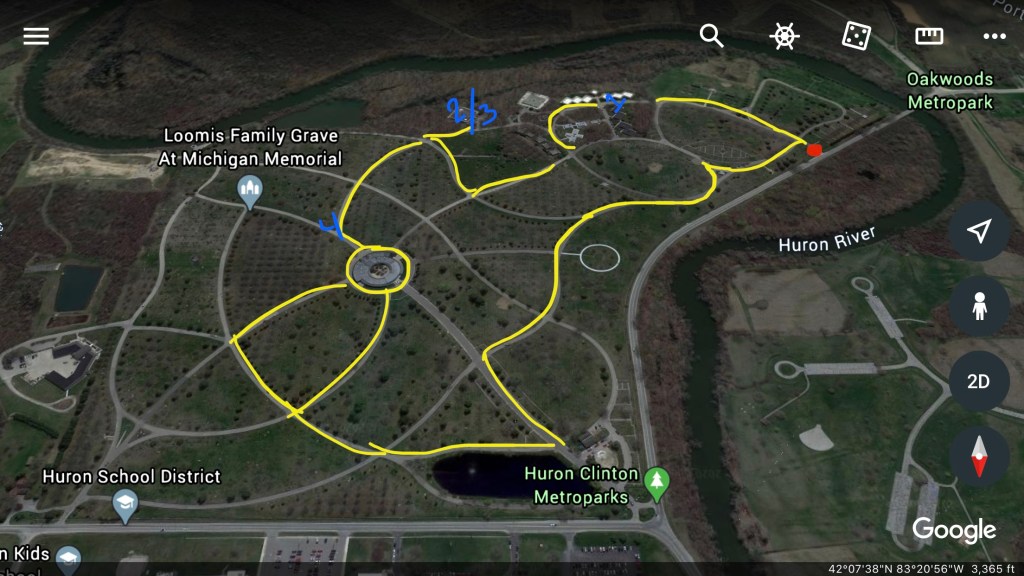
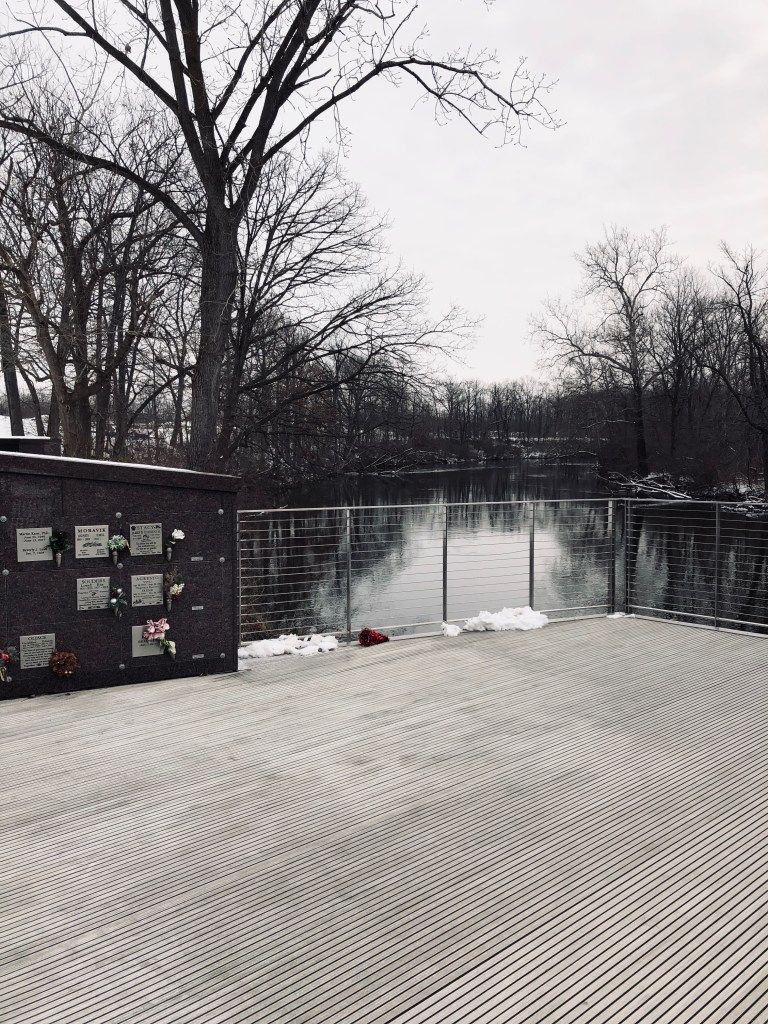
Along with my mother and two dogs, we started at the red dot on the map. We then proceeded while letting the dogs lead the way. From this map’s angle, we went straight left from the red dot towards the mausoleums (visible on the map) on the back path of the cemetery. This is where I took picture 1 indicated in blue. This family-owned cemetery is beautiful and pleasant to walk through. Its even more beautiful in the summer when its filled with flowers and wildlife. After looking at some Christmas decorations and personal monuments we continued on our walk by following the sharp left hand curve traced by another line. We then stopped after the curve for Peanut, the beige dog, to go to the bathroom, lol! And then the dogs started back up again by turning us around and going farther left along the next yellow line and turning right towards the back trails and taking another right to almost complete a full square. That is where we came upon my favorite monument, the lighthouse on the river, in pictures number 2 and 3. We then went back the way we came and, upon dog request, curved down towards where picture number 4 was taken of the central mausoleum. After stopping for a quick picture, we made the full circle around the whole building before splitting ways. My mom went with Peanut while I went with Buddy. Peanut took my mother down the farther left path while Buddy and I headed in the same direction but on the path to the right. We took our time while Peanut and mom met up with us at the intersection on the end of our path. Then the dogs headed right towards the pond in the front of the park expecting to see the beautiful swans. Sadly it is winter and the swans are kept inside this time of year. We then took a sharp left and followed the winding path back to where my car was parked.


I am glad I was able to go on this walk today. It felt freeing to break from my routine and do something unusual like going on a walk, especially in the middle of winter! Most of the time, going to a cemetery is sad and you only go to visit your lost loved ones. But going today with the intention of appreciating the beauty changed the way I feel about Michigan Memorial. My dogs had a great time and took a nice long nap once we got home.
Organization of Information
There are two different types of classification systems: taxonomy and folksonomy. Taxonomy is the formal way of classification while folksonomy is an informal form of classification done by everyday people. Taxonomy is highly organized and created by professionals who hold power. Information is organized from the beginning and falls into only one classification or group. While on the other hand folksonomy is created by the public’s opinions through social media tags. In folksonomy, information can fall into many different groups and can be found by searching any one of its many tags.
Outline of English 212
Mapping and Social Equality
-Harley
Politics and Art
-gerrymandering
-Harley maps in painting
Spatial Experience
-contested spaces
-psychogeography
Timelines
-cartographies of time
-chronology vs. history
Taxonomies
-folksonomy vs. taxonomy
a. Metadata
-visual complexity
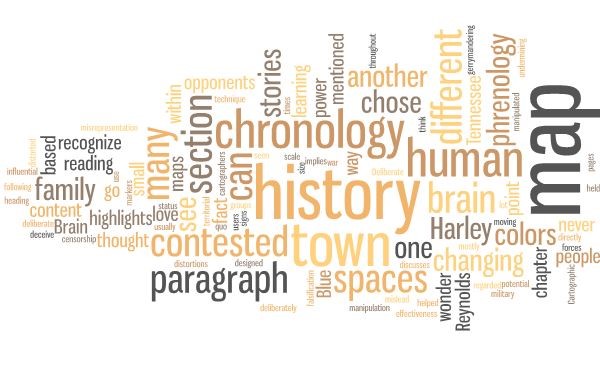
Above are examples of taxonomy and folksonomy. Taxonomy is the outline I created for my English 212 course while the word cloud is considered an expression of folksonomy for the same course. The outline is organized by sections/modules of the class and includes key topics for each. While the word cloud was created from my writing assignments thus far. The outline is very basic yet is an accurate representation of what the class consists of. The word cloud is a mix of the words included in my writing but does not give concrete details of what it was based upon. I think the word cloud shows overlooked key ideas that are taught in the course without me realizing it.
I appreciate the differences in each organizational method but I personally prefer the taxonomy method. I like things to be in traditional order and that aligns with taxonomy. Although I like the ability to find information in many different ways with folksonomy. I think that each method has conditions in which it is best suited. Taxonomy is better used for the identification of species within the animal kingdom because there are concrete lines of evolution. But folksonomy better classifies pictures and social media ideas since they can be searched using many different perspective words.
My Relationship with Writing
I honestly have never considered myself to be a good writer. Putting words together in a beautiful and meaningful way didn’t, and still doesn’t, come easy. I dedicate extra time to English and writing classes to make sure my work was up to standards. I think a major factor in the quality of writing I produce is my passion for the subject. When professors force me to write about a specif topic, it limits my creative range and makes it exponentially harder to write well. In January I wasn’t expecting this class to change my outlook the way it did. I had no idea how this course was going to change my writing and mindset.
The material we reviewed over these past few months was eye-opening. My professor challenged us and invited us to ask questions! I found myself with all this passion for the topics and problems I learned about and it changed my expectations of classes. I have gained more confidence in my writing over this past semester than I have in all my other years of schooling. I can critically think and analyze all kinds of imagery. And even better, I have learned to question what I am reading and draw conclusions based on the information. When analyzing visual-texts I have gotten good at analyzing the images to understand deeper meanings.
I have recommended this course to everyone I know because it’s been so beneficial to me and my writing skills. I am excited to continue on my education with the confidence this course has given me. I am proud to say that now, with all the work I’ve done, I consider myself a pretty good writer. I am ready to always work hard and keep getting better because it’s worth it.
 Camille's Blog